
Brexit has been an interesting subject to be discussed by the media around the world since Britain voted to leave the EU in 2016. It has caused instability haunting the UK political, economic and social life even globally (Renison, 2016). But what does Brexit really mean, especially for businesses based in London? For them, Brexit means changes in organisational management whether they like it or not (Renison, 2016). So what is the role of leadership in this change? Let us use HSBC bank as a case study to discuss the impact of Brexit on the company and leadership.

Picture credit: briefingsforbrexit.com
Brexit impact on HSBC London
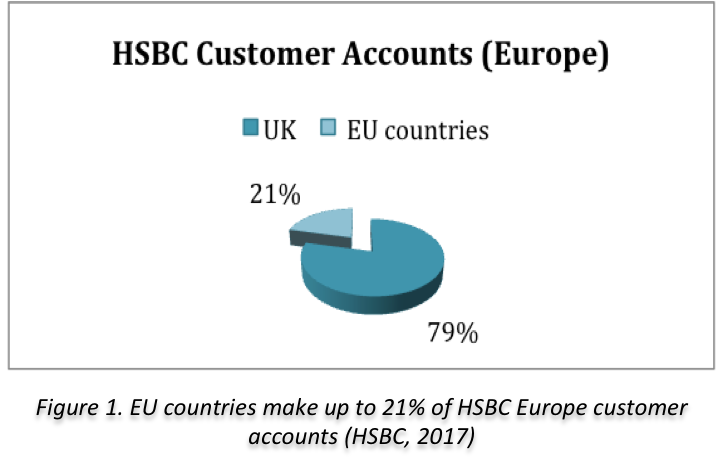
As a bank, HSBC is profoundly affected by the economic impact of Brexit such as currency exchange, loss of investment and so on. However, one of the fatal effects on HSBC London is that they are about to lose their so-called passporting rights in the EU (which is the right for UK-based banks to serve EU countries) so that they would lose their EU customers (Reuters, 2018). It will hit them hard as EU countries make up to 21% of HSBC Europe customer accounts (see figure 1; HSBC, 2017). Therefore, HSBC London has decided to shift ownership of Ireland subsidiary and seven other European branches to HSBC Paris. Following this decision around 1,000 employees will be moved from London to Paris (Reuters, 2018). The purpose of this action is for HSBC to be able to continue serving the EU customers. Consequently, relocating employees overseas brings a significant challenge for the leader of HSBC London (Reuters, 2018).
Challenges for HSBC leader
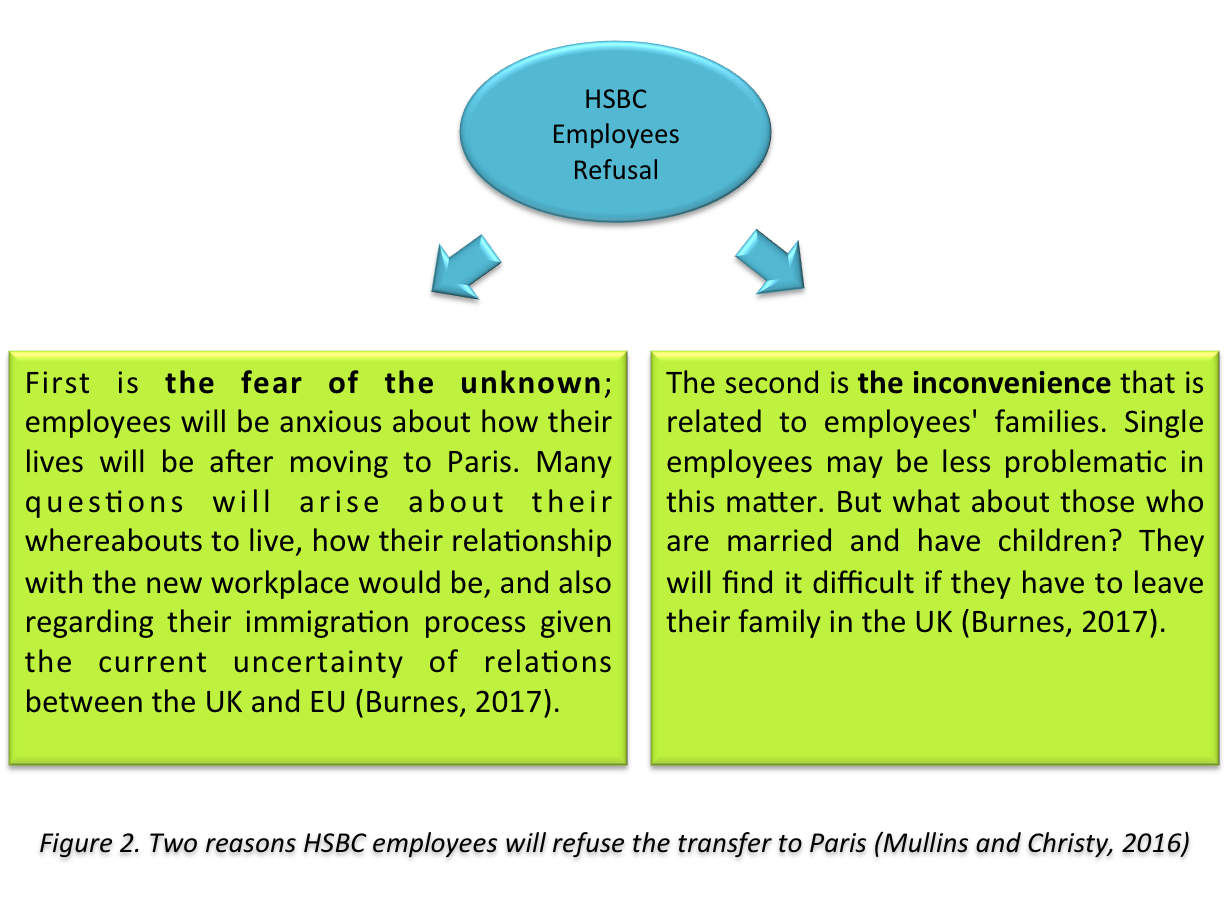
The biggest challenge for HSBC leader will be the refusal from affected employees. According to Mullins and Christy (2016), individuals reject change for several reasons. However, in the HSBC case, there are two reasons applied (see figure 2). These two reasons will cause employees to refuse this transfer to Paris (Mullins and Christy, 2016).
 Solution for HSBC leader
So how can HSBC leader manage this resistance and embrace their employees through this change? The following is the proposed action plan on how to convince employees and help them to accept this change.
According to Gobillot (2008), there are four major steps to be undertaken by leaders in managing changes; those are communicate, agree, implement, and monitor (see figure 3).
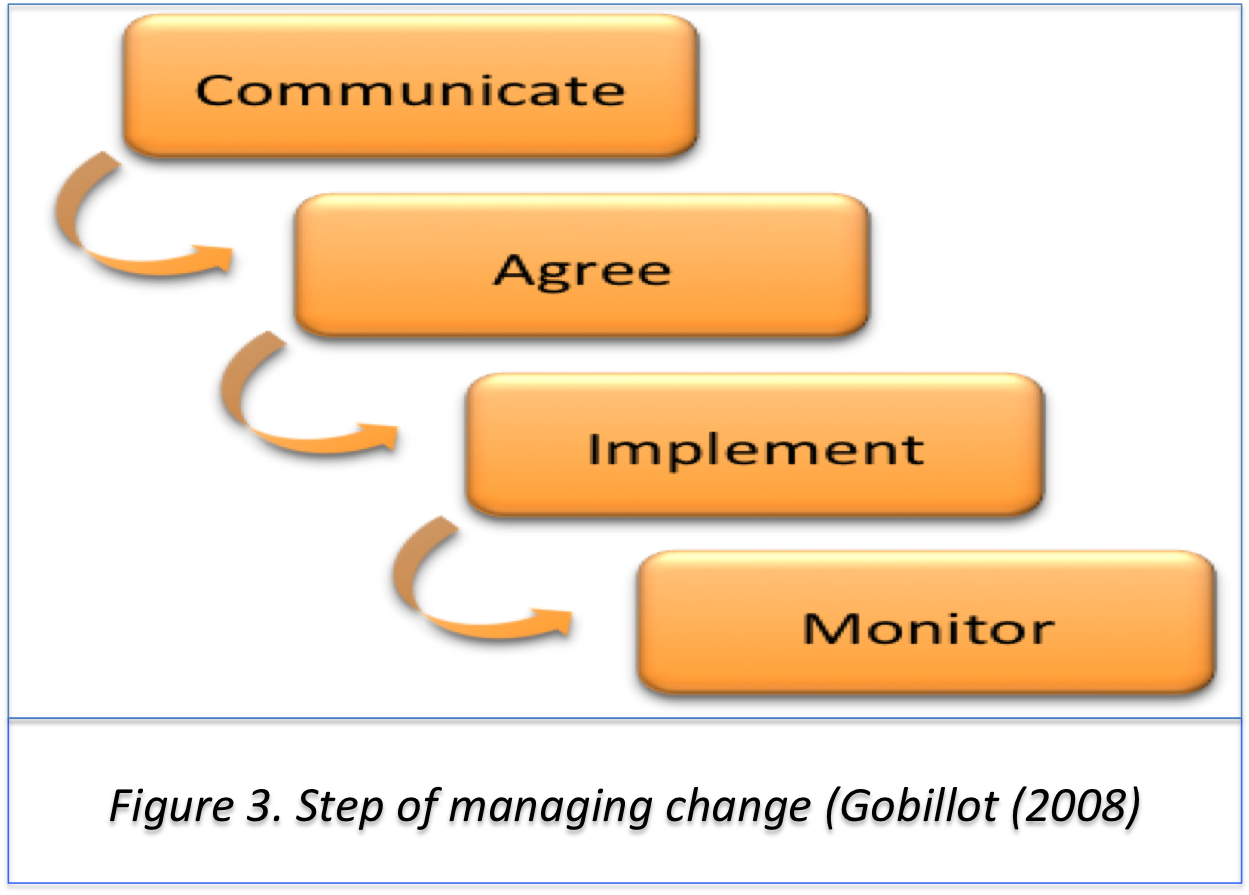
Firstly, the leader must sit with the affected employees and openly explain about HSBC’s current situation and why they should be moved to Paris. Make sure that they understand that if they do not move to Paris, HSBC will lose 21% of their customers from the EU (HSBC, 2017); and if they lose these customers, the employees will lose their jobs because the branch office for the EU customers must be closed after losing access to the EU. Clear communication at the beginning is crucial to get employees’ support towards change. This communication can be done by sending emails to the affected employees and inviting them to a workshop where the leader can talk to them in person to explain the situation as clearly as possible (Gobillot, 2008).
After the employees understand the reason for the relocation, the leader must ask for input from them regarding their concerns about this relocation; whether it is a matter of accommodation, immigration, or if they want to bring their family along to Paris. For that, the leader can ask them to send emails containing their concerns to the HR team (Gubillot, 2008). Then, the next step is to consult with HR about how to meet those needs (Rowe and Guerrero, 2013). HSBC must ensure that immigration and accommodation needs in Paris are met in time so that employees feel secure and certain about moving to Paris. As for family matters, HSBC can give choices whether families are also relocated, or employees are given a leave every three months, for example, to go home and meet their families (Cameron and Green, 2012).
After that, both HSBC and employees must agree to the plan by making a new contract and starting to move to Paris. Furthermore, the leader must ensure that the employees receive a proper induction in the new office so that they do not feel left out and able to adjust to the new environment (Armstrong and Taylor, 2014). Finally, the manager must continue to monitor for adaptation issues such as differences in language or culture so that appropriate assistance can be given. Hence, employees will feel secure and motivated to move forward (Armstrong and Taylor, 2014).
Learning outcomes
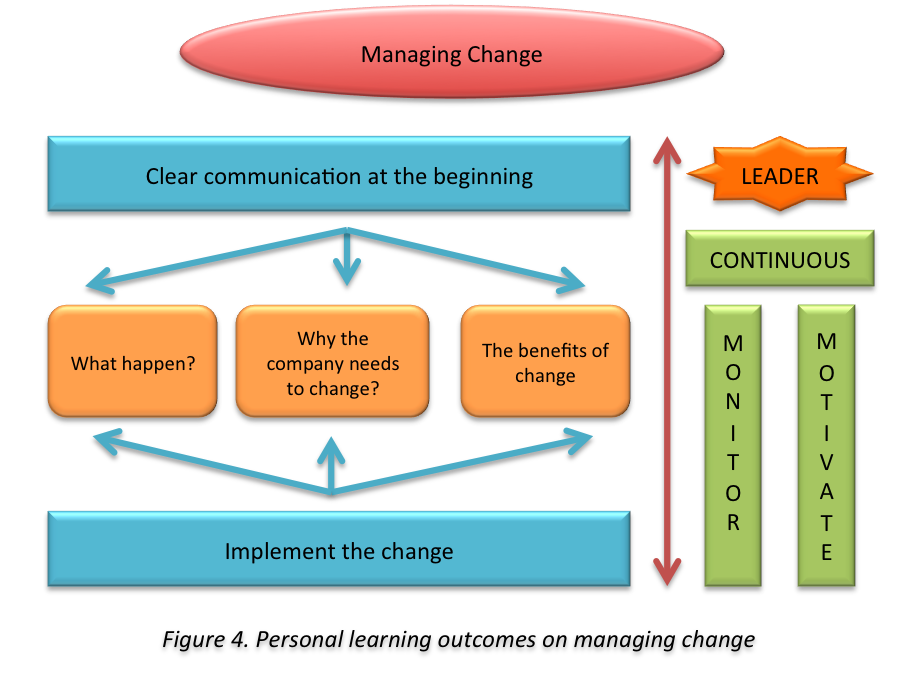
In conclusion, from the proposed action plan, I learned that (see figure 4) the key in helping employees to accept change is clear communication from the very beginning. If employees have understood the purpose of the change and see the benefits in it, then they will follow the change (Gubillot, 2008). But to get used to the change takes time. Hence in the process, leaders must continue to support and motivate employees to move forward (Gubillot, 2008).
Cheers...
 Leadership matters!
Hi Abri!
I just wanted to tell how eloquent your blog posts are. In regards to dealing with Brexit, I do believe that open communication and information transparency from the company to the employee would definitely help reduce the tension and resistance towards the changes. Furthermore, I think survey or focus group would definitely help HSBC to understand which area to consider and improve for the employee relocation plan.
Looking forward for your next post!
LikeLike
Hi Leti,
Open communication and transparency is a vital element in managing changes. People need to know why they need to change, hence transparency from the beginning is crucial.
Furthermore, I like your idea of doing a survey to find out employees’ needs for the relocation plan in which that would be faster and more efficient instead of asking employees one by one.
Anyway, thank you for commenting, have a good day.
Cheers…
LikeLike
Hi Abri!
It was a well written and an interesting piece altogether. Keep up the great work! Definitely enjoyed reading the drapes needed to be taken as a leader to implement necessary changes in their organization. It’s something that more and more companies need to adopt today. Good work!
LikeLike
Hi Bhuvi,
I agree that nowadays, more and more companies need to adopt a way of managing change in which clear communication and transparency are provided since the very beginning and towards the whole change process until the end.
Anyway, thank you for commenting, have a good day.
Cheers…
LikeLike
Hi Abri,
I couldn’t agree more about how leaders must listen to their employees and ensure that they are relocated process from London to Paris. This will be a good solution when a leader has an initiative about it. I think with a good communication process with all team members there will be a smooth process of moving out from London to keep their potential customer from EU.
LikeLike
Hi Novita,
In facing uncertainty, there is no panacea for employees other than knowing that their leader is listening to their concerns and provide all information through open communication and transparency. It would give the employees a feeling of belonging and hope for their future during an uncertain time.
Anyway, thank you for commenting, have a good day.
Cheers…
LikeLike
Hi Abri!
A greatly insightful piece of writing on how Brexit will impact the banking industry in the UK! I can’t agree more with the recommendations that you proposed for the change. However, I do not think the EU staffs would require much help with adapting to the new environment, since Paris is a part of EU and these people are originated from there. But, in case they needed one, what kind of programs should HSBC provides for their staffs to assist them with adapting?
Great work as always! Cheers!
LikeLike
Hi Aldi,
Well, although Paris in France is indeed in the EU, France is not the EU itself. Moreover, there is no guarantee that all employees are French. Here we talk about cultural differences where people from Greece or Spain, or from the UK might find it difficult to work in Paris as the culture is totally different. One example is the language barrier. Although they will speak English in the workplace, they might have to speak French at some points in their daily activities outside the office. Hence, one way HSBC can help is by providing a language training programme for those in need.
To identify other needs from its employees, one way is for HSBC to conduct a survey. And after they know the needs, they can provide the support accordingly.
I hope that would answer your question.
Anyway, thanks for commenting.
Cheers…
LikeLike
Hey abri,
This is indeed an interesting topic. I think the nature of this kind of job migration is different from the past.
Thank you for sharing the case about HSBC. I will also continue to follow HSBC’s follow-up news.
Great work.
LikeLike
Hi Yao,
As you identified that this job migration is kind of a new issue, then this case should be a very good lesson for all leaders. They should start to think of what they can do differently if they would face this kind of issue; how they can minimise employees refusal, and if there is still refusal, how they can deal with it.
I just realised that this discussion can add one more lesson for the leaders, which is: preparation could make a good leader.
Anyway, thanks for commenting.
Cheers…
LikeLike