My Development as a Future Leader

The debate about the right theory and style of leadership has been going on for a long time among the scholars and still has no answers. Allio (2013) stated that of all existing leadership theories, there is no one universal approach to fit into all leaders around the world. However, Schrage (2016) argued that smart leaders have to build their specific leadership brand for people to know them from the way they lead.

There are many examples of famous leaders who are well-known by their leadership brands such as Martin Luther King with “transformational leader” as his brand or also recent leaders such as Sir Richard Branson who is known as the “flexible leader” among the Virgin Group employees (McGuire and Hutchings, 2007; Palmer, 2014).

                                 Martin Luther King (Richard, 2017)                    Sir Richard Branson (inBizblog, 2018)

Accordingly, as an MBA student studying leadership and eager to be a smart leader in the future, hence, I also have to have my leadership brand. Here is the question arises: what is my leadership brand? To answer this question, I will use my experience as a team leader in team activities during my study at Coventry University to justify my leadership brand.

My Leadership Brand

In my leadership class last term, we did many team activities, and each member took a turn to be the team leader each week. When I was the team leader, I believe that I adhere to the situational leadership approach. This approach suggests that the leadership style of a leader is adjusted accordingly to the situation of the followers (Chapman, 2018). This is exactly what I did when leading my team.

leader-behavior

 Situational Leadership Model (picture credit: atodorov.org)

As I recall, I got the first turn to be the leader in the first week. Leading a newly formed team is not an easy task. I had to learn the characters of each member to apply the right leadership approach (Harvey, 2012). For example, I learned that some members like to talk and express opinions, while some were quiet and shy. Thus, as the leader, I adjusted my approach to these different behaviours. I listened more and gave less direction when interacting with those who like to speak, while I talk more to guide those who were shy to speak. Besides, some members did not speak fluent English, so I had to slow my pace when dealing with them. I found that by embracing this situational leadership, I managed to lead the team without giving the impression of ignoring those who were shy and faced language difficulties.

Team Activities in Leadership Class

In addition, I also adhere to flexible leadership as used by Sir Richard Branson (Palmer, 2014). Flexible leadership is not only about the ability to adapt our leadership styles, but also about our readiness to take the lead when needed (Landin, 2017). For instance, I took over the position of the leader several times because the leader was not present in the class and the other members were not ready to take over. Then I got feedback from the team members who said that my flexibility was very helpful in moving the team forward.

Furthermore, I believe that a flexible style and situational leadership will be the best fit for me when I become a real leader in the future. When I graduate from university, I will return to Indonesia and work in the field of charity and education with a team of young people from the millennial generation who want freedom in doing the job. However, at one point, I will also be dealing with the older generations (baby boomers) who have different behaviours (Hou, 2017). With flexibility as my leadership brand, I will be able to lead these various behaviours of different generations (Yukl, 2008).

Blog 2

Difference between millennials and baby boomers behaviours (Hou, 2017)

However, to be a successful leader in today’s changing world, I have to possess certain traits, one of which is the ability to calm down under pressure (Maguire, 2012). Despite the positive feedback I got from my colleagues about flexibility, I evaluate that when pressure came, one example was time pressure to complete group assignments, I went panic and forced the team to speed up the work which gave us poor results. Thus, I plan to develop my calmness, and if I face the same situation again, I will encourage the team to slow down the action, keep calm and stay focused. As according to Kang (2012), the calmness of a leader is a panacea for the anxiety of followers in keeping up with today’s rapid changes.

Overall, I believe that flexible leadership under the situational leadership approach will be the answer to the long debate of finding one universal leadership style; in which if I can adapt, I can be a good leader wherever and whenever needed (Palmer 2014; Chapman, 2018).


Cheers...


References

Allio, R. (2013). Leaders and leadership – many theories, but what advice is reliable?. Strategy & Leadership, [online] 41(1). Available at: https://search.proquest.com/docview/1282274711?accountid=10286&rfr_id=info%3Axri%2Fsid%3Aprimo [Accessed 5 Jan. 2019].

Chapman, B. (2018). Situational Leadership. Leadership Excellence Essentials, [online] 35(9). Available at: https://search.proquest.com/docview/2117739881?accountid=10286&rfr_id=info%3Axri%2Fsid%3Aprimo [Accessed 5 Jan. 2019].

Harvey, I. (2012). Team building not as easy as ABC. Bottom Line, [online] 28(4). Available at: https://search.proquest.com/docview/1017916047?accountid=10286&rfr_id=info%3Axri%2Fsid%3Aprimo [Accessed 5 Jan. 2019].

Hou, X. (2017). Multilevel Influence of Destructive Leadership On Millennial Generation Employees’ Innovative Behavior. Social Behavior and Personality: an international journal, [online] 45(7), pp.1113-1126. Available at: https://search.proquest.com/docview/1951872116?accountid=10286&rfr_id=info%3Axri%2Fsid%3Aprimo [Accessed 5 Jan. 2018].

Kang, I. (2012). The Thoughtful Leader. Boxoffice, [online] 148(12). Available at: https://search.proquest.com/docview/1284329006?accountid=10286&rfr_id=info%3Axri%2Fsid%3Aprimo [Accessed 5 Jan. 2019].

Landin, J. (2017). Keys To Flexible Leadership. Strategic Finance, [online] 99(4). Available at: https://search.proquest.com/docview/1947782275?accountid=10286&rfr_id=info%3Axri%2Fsid%3Aprimo [Accessed 5 Jan. 2019].

Maguire, T. (2012). 4 leadership traits. Canadian HR Reporter, [online] 25(20). Available at: https://search.proquest.com/docview/1223520993?accountid=10286&rfr_id=info%3Axri%2Fsid%3Aprimo [Accessed 5 Jan. 2019].

McGuire, D. and Hutchings, K. (2007). Portrait of a transformational leader: the legacy of Dr Martin Luther King Jr. Leadership & Organization Development Journal, [online] 28(2). Available at: https://search.proquest.com/docview/226921078?accountid=10286&rfr_id=info%3Axri%2Fsid%3Aprimo [Accessed 5 Jan. 2019].

Palmer, A. (2014). Four skills all business leaders need. [online] Available at: https://search.proquest.com/docview/1522532390/abstract/8E455C60B7304504PQ/1?accountid=10286 [Accessed 5 Jan. 2019].

Schrage, M. (2016). Like It or Not, You Are Always Leading by Example. Harvard Business Review. [online] Available at: https://hbr.org/2016/10/like-it-or-not-you-are-always-leading-by-example [Accessed 5 Jan. 2019].

Yukl, G. (2008). The Importance of Flexible Leadership. San Fransisco.

Change Management

Brexit has been an interesting subject to be discussed by the media around the world since Britain voted to leave the EU in 2016. It has caused instability haunting the UK political, economic and social life even globally (Renison, 2016). But what does Brexit really mean, especially for businesses based in London? For them, Brexit means changes in organisational management whether they like it or not (Renison, 2016). So what is the role of leadership in this change? Let us use HSBC bank as a case study to discuss the impact of Brexit on the company and leadership.

brexit-and-the-eu-810x456

Picture credit: briefingsforbrexit.com

Brexit impact on HSBC London

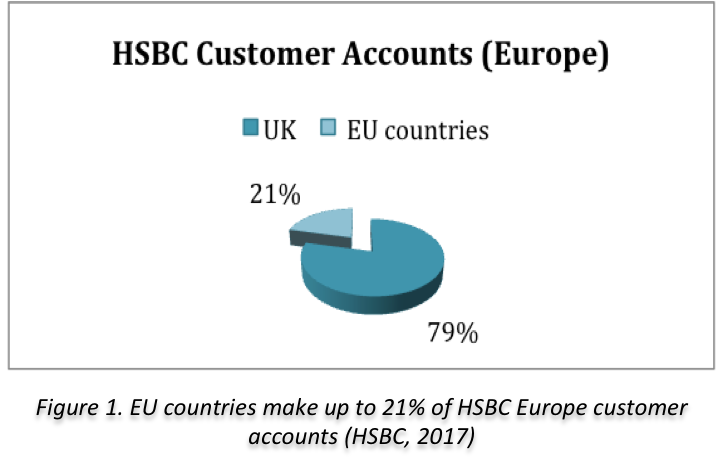
As a bank, HSBC is profoundly affected by the economic impact of Brexit such as currency exchange, loss of investment and so on. However, one of the fatal effects on HSBC London is that they are about to lose their so-called passporting rights in the EU (which is the right for UK-based banks to serve EU countries) so that they would lose their EU customers (Reuters, 2018). It will hit them hard as EU countries make up to 21% of HSBC Europe customer accounts (see figure 1; HSBC, 2017). Therefore, HSBC London has decided to shift ownership of Ireland subsidiary and seven other European branches to HSBC Paris. Following this decision around 1,000 employees will be moved from London to Paris (Reuters, 2018). The purpose of this action is for HSBC to be able to continue serving the EU customers. Consequently, relocating employees overseas brings a significant challenge for the leader of HSBC London (Reuters, 2018).

HSBC

Challenges for HSBC leader

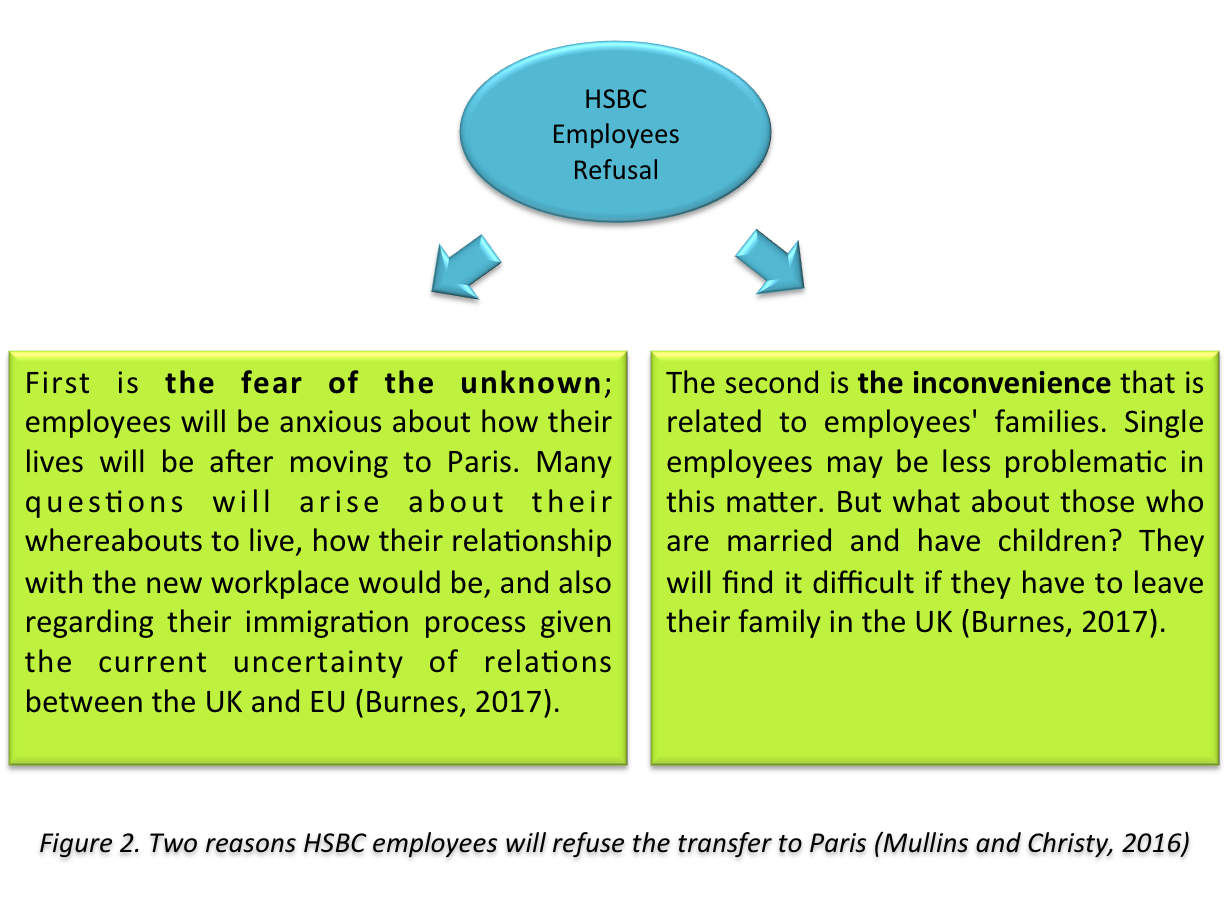
The biggest challenge for HSBC leader will be the refusal from affected employees. According to Mullins and Christy (2016), individuals reject change for several reasons. However, in the HSBC case, there are two reasons applied (see figure 2). These two reasons will cause employees to refuse this transfer to Paris (Mullins and Christy, 2016).

HSBC RefusalSolution for HSBC leader

So how can HSBC leader manage this resistance and embrace their employees through this change? The following is the proposed action plan on how to convince employees and help them to accept this change.

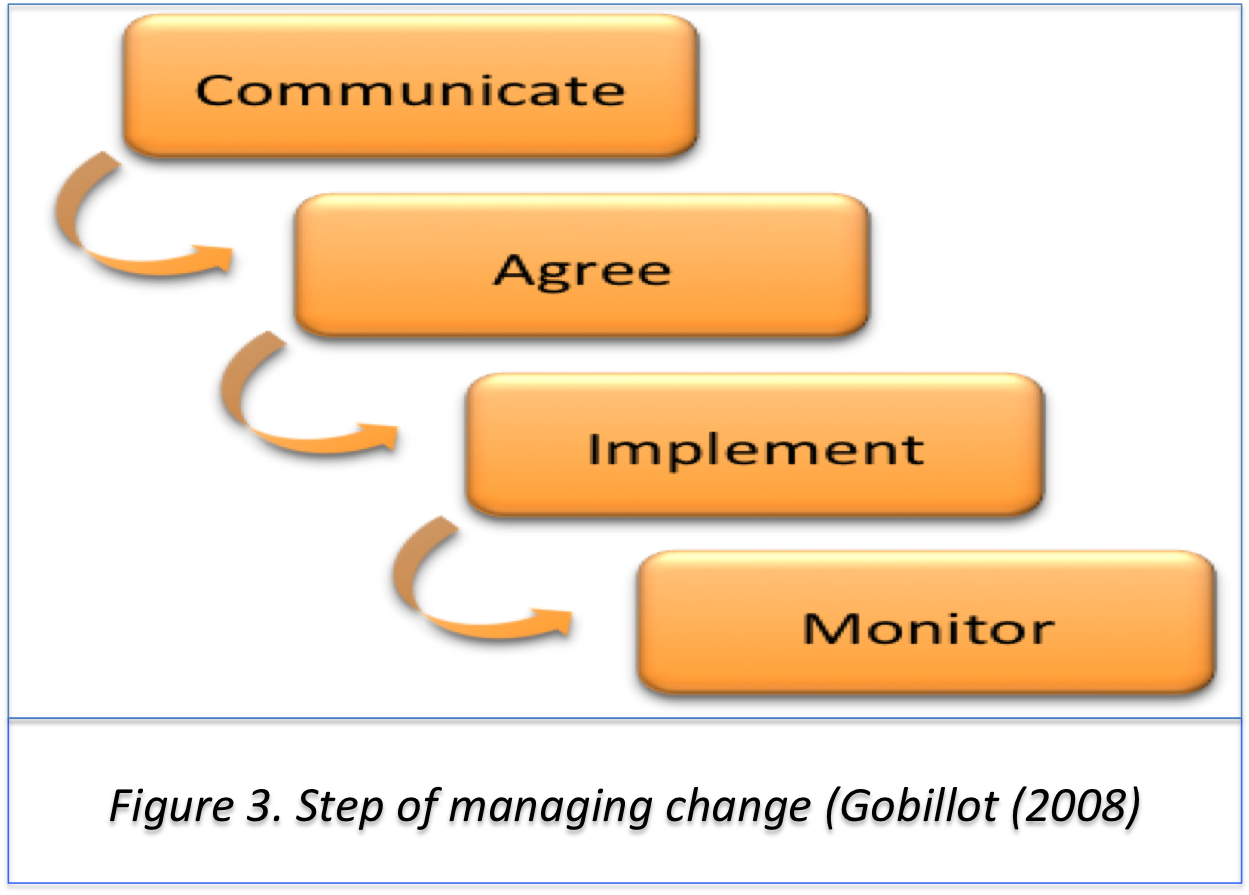
According to Gobillot (2008), there are four major steps to be undertaken by leaders in managing changes; those are communicate, agree, implement, and monitor (see figure 3).

Change step

Firstly, the leader must sit with the affected employees and openly explain about HSBC’s current situation and why they should be moved to Paris. Make sure that they understand that if they do not move to Paris, HSBC will lose 21% of their customers from the EU (HSBC, 2017); and if they lose these customers, the employees will lose their jobs because the branch office for the EU customers must be closed after losing access to the EU. Clear communication at the beginning is crucial to get employees’ support towards change. This communication can be done by sending emails to the affected employees and inviting them to a workshop where the leader can talk to them in person to explain the situation as clearly as possible (Gobillot, 2008).

After the employees understand the reason for the relocation, the leader must ask for input from them regarding their concerns about this relocation; whether it is a matter of accommodation, immigration, or if they want to bring their family along to Paris. For that, the leader can ask them to send emails containing their concerns to the HR team (Gubillot, 2008). Then, the next step is to consult with HR about how to meet those needs (Rowe and Guerrero, 2013). HSBC must ensure that immigration and accommodation needs in Paris are met in time so that employees feel secure and certain about moving to Paris. As for family matters, HSBC can give choices whether families are also relocated, or employees are given a leave every three months, for example, to go home and meet their families (Cameron and Green, 2012).

After that, both HSBC and employees must agree to the plan by making a new contract and starting to move to Paris. Furthermore, the leader must ensure that the employees receive a proper induction in the new office so that they do not feel left out and able to adjust to the new environment (Armstrong and Taylor, 2014). Finally, the manager must continue to monitor for adaptation issues such as differences in language or culture so that appropriate assistance can be given. Hence, employees will feel secure and motivated to move forward (Armstrong and Taylor, 2014).

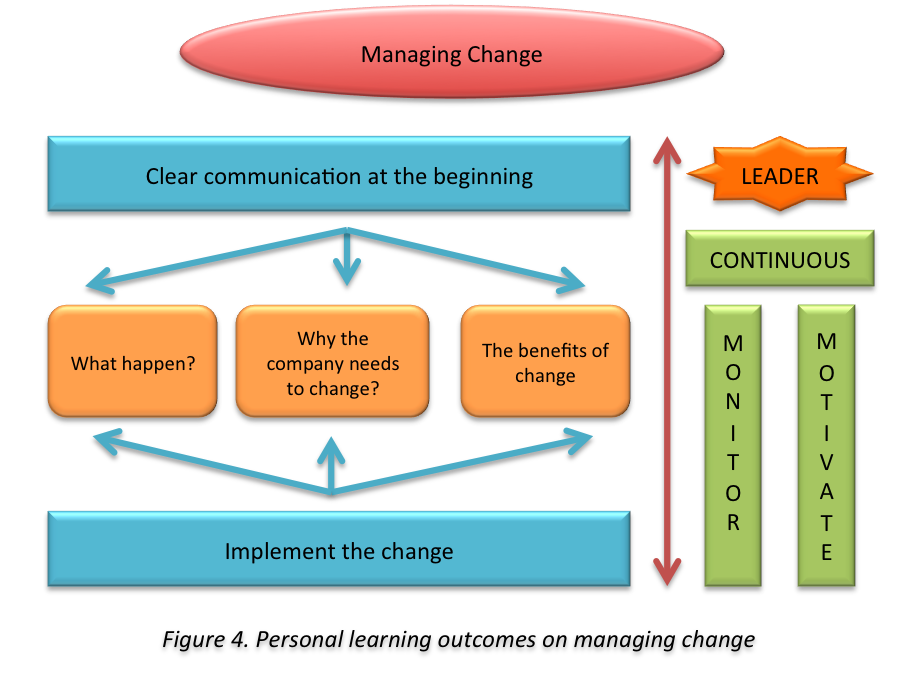
Learning outcomes

In conclusion, from the proposed action plan, I learned that (see figure 4) the key in helping employees to accept change is clear communication from the very beginning. If employees have understood the purpose of the change and see the benefits in it, then they will follow the change (Gubillot, 2008). But to get used to the change takes time. Hence in the process, leaders must continue to support and motivate employees to move forward (Gubillot, 2008).

Learning outcomes

Cheers...

Contemporary leadership style: How relevant are they in today’s changing world?

In the 21st century, the way business works have transformed; it is no longer about a leader telling employees what to do, but more about the flows of knowledge and ideas between employees and leaders on how to achieve their goals (Uhl-Bien, Marion, and McKelvey, 2007). This change has a significant impact on the practice of leadership in today’s organisations. Many scholars have been criticising that the practice of autocratic leadership from the 20th century that gives absolute power to the leader to make all decisions in the organisation is no longer suitable in this era (Fuda, 2014).

Reasons for Criticism

There are two reasons for this criticism. The first reason is that of the rise of millennials generation who began to take positions in organisations following the elderly (Hou, 2017). So how do these millennials affect leadership? (See figure 1).

Blog 2

It can be seen from figure 1 that millennials and the elderly show different behaviours in the workplace. These different ways of thinking require a different leadership approach; otherwise, it will cause chaos. If the leader in a company exercises the autocratic style, the elderly might easily follow the leader as they like to be told and having clear instruction of what to do. On the other hand, the juniors will be disappointed because they cannot freely express their ideas (Fuda, 2014).

For instance, in Virgin Group, Sir Richard Branson has been practicing flexible leadership style by giving freedom and flexibility for employees to think, work, even dress (BBC, 2016; Yukl, 2008). He found that this approach was more suitable for millennial employees. However, the HR department found some challenges from the so-called baby boomers generation; for them, knowledge is power, so they did not want to share all their experience and work on the need-to-know basis (BBC, 2016). It shows that today’s leaders face challenges in how to lead two different generations within the same company. For the older generation, the autocratic approach might be more fit; while for the younger generation, a flexible approach might be more suitable (Varey, 2017).

virgin-australia-airlines-office

Picture credit: Glassdoor.co.uk

The second reason is the fact that autocratic leadership theory comes from the western world; as according to Watson and Rosser (2008) that the development of this theory was focused on white-American men and also written by white-American men; so that they are not universally applicable (Keyt, 2015). According to Hofstede (1984), the culture of each country influences the leadership style in each nation. Therefore, the theories of leadership that considered valid in western countries may not be suitable in Asian countries. However, Hofstede (1984) added that the words “western” or “Asian” or “African” and so on need to be further justified. Because, even though some countries are located in the same region, their cultures would be totally different.

Let us use Japan and Indonesia for example. It can be seen in figure 2 that, although both are Asian countries, Japan and Indonesia have different cultures. For instance, Japan scores high in the masculinity dimension while Indonesia scores low which is considered a feminine culture (Hofstede Insights, 2018). It implies that a strict and goal-oriented western leadership style such as autocratic style might be suitable in Japan but not in Indonesia. On the other hand, feminine leadership; which defined as people-oriented leadership that prioritises employees’ emotions and social life in achieving the ultimate goal (Saseanu, Toma and Marinescu, 2014); may be ideal in Indonesia (Hofstede Insights, 2018).

blog 2..

Gap for Further Research

The two reasons for the criticism against the traditional autocratic leadership above identify the needs for further research in the future regarding leadership in the changing world. Firstly, scholars need to examine the millennials’ perspective towards leadership; for example, which leadership style is suitable for them to help leaders in leading this new generation of workforce. This research is crucial as if leaders are unable to adapt to this changing behaviour, organisations will fail to keep the millennials, and they will walk away (Hou, 2017). Secondly, scholars need to examine more profound cultural differences in each country around the globe so that they can determine the right leadership style for each nation and not be generalised as western or Asian or African and so on (Hofstede, 1984).

Furthermore, there is also a need for more in-depth research on the definition of feminine leadership. As masculinity can be related to autocratic leadership (Hofstede Insight, 2018), what style of leadership is under feminine culture? Is it all about people-oriented leaders who pay attention to the emotions of employees? Or is it a blending of flexible leadership that able to adjust the approach according to the behaviours of the follower, just like Sir Richard Branson did in Virgin Group? Can Sir Richard Branson, for example, be considered as a feminine leader? All these questions are to be considered by researchers to help today and future leaders.

So, here is the question for you, future leaders. What are you going to do if you have to lead people who come from different cultures and generations? Share your thoughts in the comments below.

Cheers...

References

BBC News. (2016). The millennial generation shaking up the workplace rules. [online] Available at: https://www.bbc.co.uk/news/business-35460401 [Accessed 26 Nov. 2018].

Fuda, P. (2014). Leadership Transformed. 2nd ed. London: Profile Books.

Hofstede Insights. (2018). Country Comparison – Hofstede Insights. [online] Available at: https://www.hofstede-insights.com/country-comparison/indonesia,japan/ [Accessed 26 Nov. 2018].

Hofstede, G. (1984). Cultural dimensions in management and planning. Asia Pacific Journal of Management, [online] 1(2), pp.81-99. Available at: https://my.uopeople.edu/pluginfile.php/57436/mod_book/chapter/38890/BUS2207U2Text4.pdf [Accessed 26 Nov. 2018].

Hou, X. (2017). Multilevel Influence of Destructive Leadership On Millennial Generation Employees’ Innovative Behavior. Social Behavior and Personality: an international journal, [online] 45(7), pp.1113-1126. Available at: https://search.proquest.com/docview/1951872116?accountid=10286&rfr_id=info%3Axri%2Fsid%3Aprimo [Accessed 26 Nov. 2018].

Keyt, A. (2015). Myths & mortals. New Jersey: Wiley, Inc.

Saseanu, A., Toma, S. & Marinescu, P. 2014, “Feminine leadership and organisational culture”, Manager, , no. 19.

Uhl-Bien, M., Marion, R. and McKelvey, B. (2007). Complexity Leadership Theory: Shifting leadership from the industrial age to the knowledge era. The Leadership Quarterly, [online] 18(4), pp.298-318. Available at: https://ac.els-cdn.com/S1048984307000689/1-s2.0-S1048984307000689-main.pdf?_tid=2961fa3a-1282-45ac-8b7c-de41d6f4bad1&acdnat=1543234788_7bfa7de35ca61550fa91c909d5425456 [Accessed 26 Nov. 2018].

Varey, R. (2017). Fearless Leadership. Matador.

Watson, A. and Rosser, M. (2008). The Emergence of African-American Leaders in American Society.

Yukl, G. (2008). The Importance of Flexible Leadership. San Fransisco.
Can culture be managed within organisations?

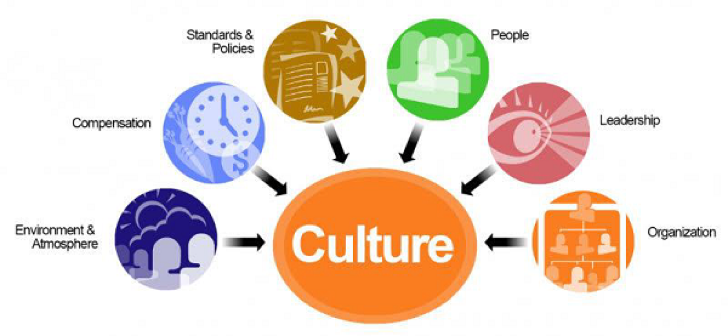
Organisational culture is all about how the residents of the organisation do their work based on their values ​​and beliefs, and usually, the culture is built by the leaders of the organisation (Trompenaars and Turner, 2004). However, according to Haris and Moran (2011), building a strong organisational culture takes a quite long time and cannot happen overnight. Haris and Moran (2011) added that the culture that had been built for a long time would be challenging to change.

OC

Picture credit: http://shamris.blogspot.com/

On the other hand, in the current era of globalisation, organisations are required to continue to adapt to external changes to be able to survive (Burke, 2002). Consequently, this forces organisations to change their culture to adjust.

Here is where the question arises: can culture be managed when change is needed in the organisation? And how is the role of leaders in bringing their organisations through this change? To discuss these questions, let us use the cultural problems experienced by United Airlines as a case study.

The United Airlines Case

This American airline recently harvested criticism from customers due to abysmal customer service. One case was in 2017 when its flight attendance called law enforcement to get on the plane and forcibly pulled a passenger out of the aircraft as this passenger refused to give up his seat (Business Insider, 2018). Another case was when a flight attendant ordered a passenger to put her dog in the overhead cabin during a 4-hour flight, hence the dog ran out of oxygen and was found dead after landing (Business Insider, 2018).

united-airlines

Picture credit: napolike.it

These cases occurred due to the wrong practice of organisational culture. United Airlines employees are required to prioritise efficiency and timeliness to depart that led them to neglect the comfort and safety of passengers and their baggage. This is remarkably against their value, which is “we fly right and friendly” (United Airlines, 2018). This happens because there is no clarity from the leader on how the value should be applied in day-to-day activities while maintaining the efficiency of the flights. The leader must clarify that the “fly right” starts from the check-in desk to the baggage collection at the destination airports. All employees must serve passengers and handle their baggage properly and according to procedures. If this was clear, the incident of placing a dog in the upper cabin that violates the aviation procedure could be avoided. Likewise with the purpose of “fly friendly”; it must be clear that whenever problems or complaints from customers occurred, they must be handled politely and responsibly. Again if this was clear, the incident of forced removal of a passenger from the aircraft could be avoided.

How to Manage The Culture

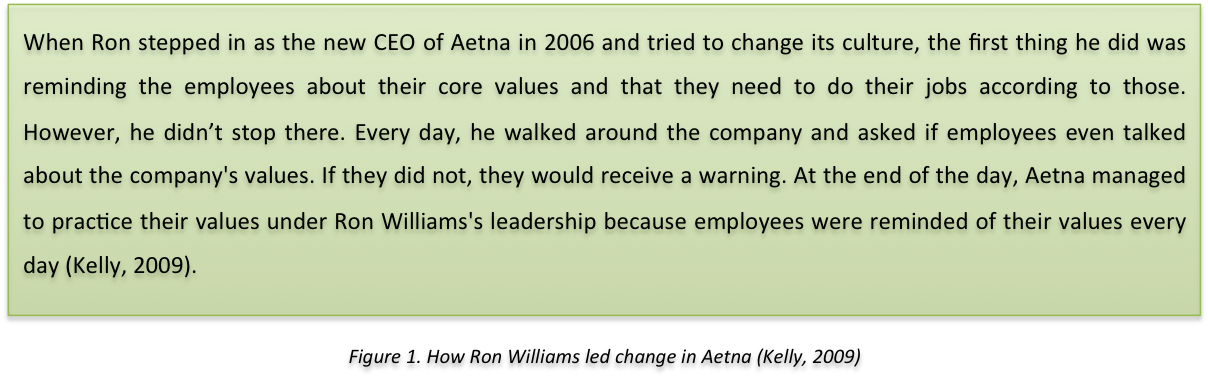
So how can they change this misguided culture? Atkinson and Frechette (2011 cited in Mullins, 2016) suggested that first, the leader must change the organisational climate to be healthier. The leader must give clarity about the value that underlies United Airlines, which is “fly right and friendly”, and clearly communicates the reason of why they need to change their poor customer service as they have been receiving many complaints from customers. Simultaneously, the leader must continuously remind the employees of United Airlines’ value. This can be done by writing down the value on posters and stick them around the office and inside the aircraft (Burnes, 2017). However, it should not only be a poster on the wall. The leader must go around and monitor whether the employees serve “right and friendly” or not (Kelly, 2009). The leader of United Airlines can learn from Aetna’s former CEO Ron Williams as an example (see figure 1).

Ron Williams Example

On the other hand, Lewin (cited in Mullins, 2016) maintained that changes in organisations are not easy and will go through three stages namely unfreeze (identify the need for change), change (implement the change), and refreeze (get used to new behaviour). Let us see how they are applied to United Airlines case (see figure 2).

Lewin's 3 stagesFrom the above explanation (see figure 2) it can be seen that when change is needed in an organisation, the role of the leader is not only about communicating the reasons for change but also walking with employees through all stages of change by monitoring, motivating and even warning those who are not committed to change. Because according to Yukl (2013), the process of change is a very stressful time, and if the leader is gone missing during the process, the employees will lose direction and will choose to go back to the unfreezing stage instead of moving forward towards the refreezing stage.

Conclusion

In the end, managing change is not impossible. Organisations that struggle with change can learn from success stories such as British Airways that totally restructured their entire organisation but still they survived and succeeded (Grugulis and Wilkinson, 2002). The key is to have clear communication between the leader and employees about the reason of change, and also to have clarity of company’s values as well as having a responsible leader to embrace employees through changes together.

So, here is the question for you, future leaders. Do you think culture can be managed in organisations? Share your thoughts in the comments below.

Cheers...


References

Armstrong, M. (2009). Armstrong’s handbook of performance management. 4th ed. Kogan Page.

Burke, W. (2002). Organization Change. Sage Publication Inc.

Burnes, B. (2017). Managing Change. 7th ed. Pearson.

Business Insider. (2018). United Airlines has a long history of infuriating customers — here are its worst customer service incidents. [online] Available at: http://uk.businessinsider.com/united-airlines-worst-customer-service-incidents-2018-3/#when-it-killed-a-dog-2 [Accessed 22 Nov. 2018].

Grugulis, I. and Wilkinson, A. (2002). Managing Culture at British Airways: Hype, Hope and Reality. Long Range Planning, [online] 35(2), pp.179-194. Available at: https://ac.els-cdn.com/S0024630102000365/1-s2.0-S0024630102000365-main.pdf?_tid=b47de8c2-1b2d-46c0-9f15-edb0d187ebca&acdnat=1542915184_29eb2d1b218083ce3b4cb10a30c80b26 [Accessed 22 Nov. 2018].

Harris, P. and Moran, S. (2011). Managing cultural differences. 8th ed. New York: Routledge.

Kelly, P. (2009). Organization culture Values and the way things are done here. [online] Cws.cengage.co.uk. Available at: http://cws.cengage.co.uk/colekelly7/students/Video%20Cases/Chapter%2013%20-%20Video%20Case%20Study%2084.pdf [Accessed 22 Nov. 2018].

Mullins, L. (2016). Management & Organisational Behaviour. 11th ed. Pearson.

Trompenaars, F. and Turner, C. (2004). Managing People. Capstone.

United Airlines. (2018). Our shared purpose. [online] Available at: https://hub.united.com/sp/purposes/?_ga=2.121185293.466115730.1542983668-1718301217.1542832692 [Accessed 22 Nov. 2018].

Yukl, G. (2013). Leadership in Organizations. 8th ed. Pearson.